News
Why Africa's electric mobility is no longer a venture bet
As I sat in the cramped office of an electric mobility startup in Lagos, listening to their pitch, I couldn't help but think about the shift in the tides of investment in the sector. For years, startups like this one were seen as a bet on an unproven market, a venture that many investors were wary of. But that's no longer the case. Today, electric mobility is no longer a venture bet, and the numbers tell the story.
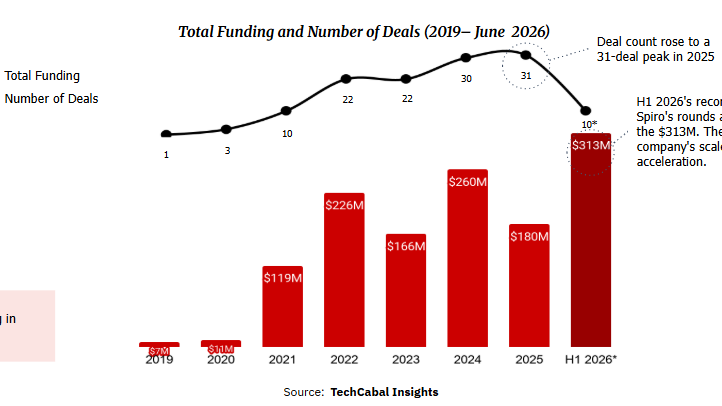
According to the TechCabal Insights Deal Tracker, startups in the electric mobility sector have raised over $1.28 billion since 2019. What's striking is the type of capital that's now flowing into the sector. While equity still leads at 65% of the total, debt has climbed to 34% ($437 million), from nothing in 2019, and overtook equity in 2023. This shift to debt financing is a clear signal that the sector is maturing.
The African Development Bank (AfDB) is also recognizing this shift. According to Wale Shonibare, the director of energy financial solutions, policy and regulation, the Bank's approach to supporting e-mobility operators is evolving. Financing is now contingent on three conditions: scalable, commercially viable business models, predictable revenue streams, and an enabling regulatory environment. To back this transition, AfDB is developing the Green Mobility Facility for Africa (GMFA), a blended finance platform expected to mobilize more than $300 million to unlock commercial lending, support pipeline development, and deploy capital through a mix of instruments including guarantees and financial intermediation with commercial banks.
The sector is also seeing the emergence of larger rounds. Since 2021, rounds of $10 million or more have taken at least three-quarters of annual funding. This indicates that companies are now securing funding for build-out, rather than just experiments. The market is no longer just funding proof-of-concept projects, but is now investing in scalable business models.
In the first half of 2026 alone, the sector raised $313 million, more than all of 2025, on just ten deals. However, this record is somewhat skewed by Spiro, the electric two-wheeler and battery-swap company, which accounts for about $272 million of it. While Spiro’s scale-up is a significant development, the sector's overall growth is still driven by a handful of large deals.
- Startups in the electric mobility sector have raised over $1.28 billion since 2019.
- Debt now funds a third of the sector, capital is arriving in larger rounds, and companies are increasingly looking like infrastructure operators.
- The African Development Bank is developing the Green Mobility Facility for Africa (GMFA), a blended finance platform expected to mobilize more than $300 million.
As I reflect on the shift in the tides of investment in Africa’s electric mobility sector, I'm struck by the fact that this shift is not just a reflection of changing market conditions, but also evidence of the perseverance of entrepreneurs and investors who saw the potential in this sector from the beginning. Today, electric mobility is no longer a venture bet, but a sector that's now being financed like infrastructure. And as the market continues to grow, I have no doubt that we'll see even more innovative solutions emerge, transforming the way we think about transportation in Africa.