News
Why Spiro deployed 22,000 electric motorcycles in Rwanda but only 5,000 in Nigeria
Rwanda's Electric Edge
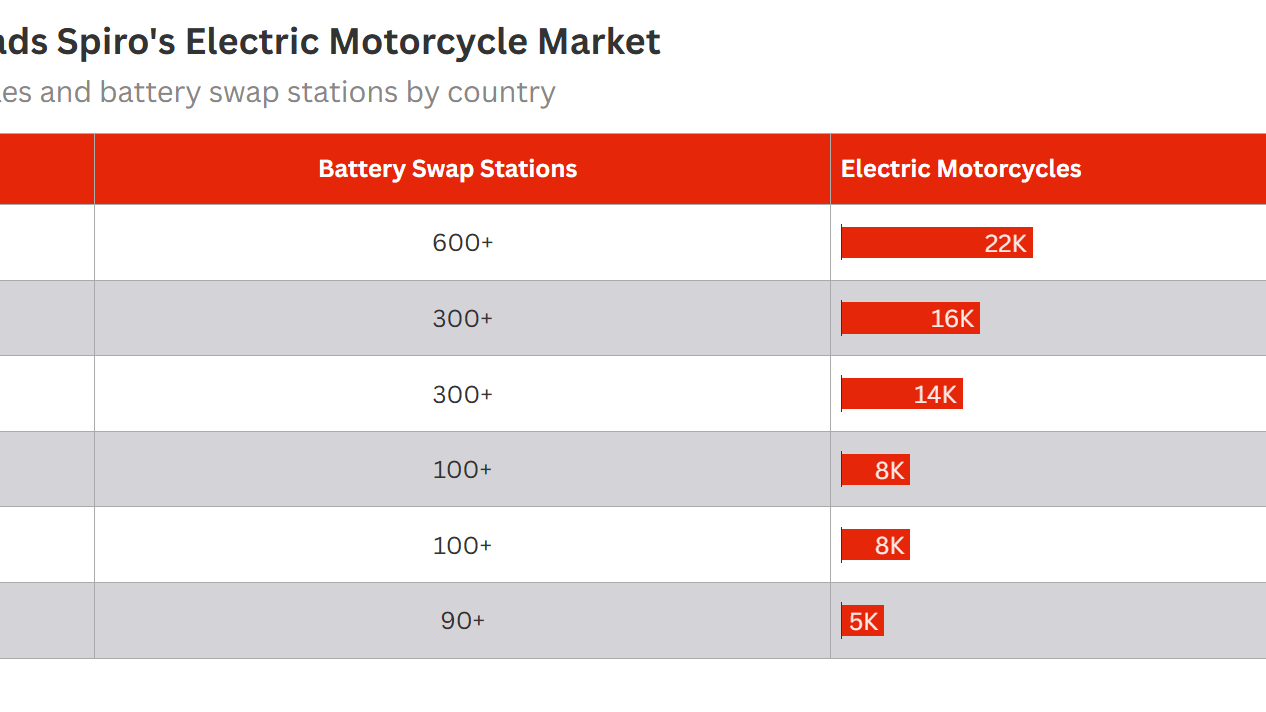
In Kigali, the capital of Rwanda, you'll find an electric mobility company called Spiro, which has deployed an impressive 22,000 electric motorcycles and over 600 battery-swapping stations. This number is staggering, especially when compared to Nigeria, where Spiro has only deployed 5,000 electric motorcycles, despite having a population more than 40 times larger. This disparity raises questions about the company's strategy and how it determines where to invest its resources.
Rwanda, with a population of around 13 million, has become Spiro's largest operation across its six African markets, surpassing Uganda's 16,000 bikes, Kenya's 14,000, and Togo and Benin's 8,000 each. Spiro's group chief executive, Anant Badjatya, attributes the company's success in Rwanda to a combination of factors, including an early market entry, supportive government policy, and years of infrastructure investment. Rwanda's government has been a key player in promoting electric mobility, particularly in Kigali, where measures have accelerated EV adoption. This alignment has allowed Spiro to scale its infrastructure rapidly, making it an attractive location for the company to deploy its electric motorcycles.
In an interview with TechCabal, Badjatya highlighted the importance of infrastructure in supporting electric mobility. "In a business that depends on batteries, swap stations, and assembly plants, a year's head start can make a significant difference," he said. This emphasis on infrastructure is crucial, as it underscores the need for a supportive ecosystem to facilitate the adoption of electric vehicles. Spiro's approach in Rwanda showcases the company's willingness to invest in infrastructure, which has paid off in the form of a robust electric motorcycle fleet.
Spiro's deployment in Nigeria, however, has been more modest, with only 5,000 electric motorcycles. Badjatya attributes this to the complexity of the Nigerian market, which requires a different approach. "Nigeria is a much larger and more complex market, so our strategy has been to build progressively, not only deploying motorcycles and infrastructure but also building the industrial backbone needed to support a much larger market," he said. This approach suggests that Spiro is taking a more cautious approach in Nigeria, prioritizing the development of a robust infrastructure before scaling up its operations.
- Spiro has deployed 22,000 electric motorcycles and over 600 battery-swapping stations in Rwanda.
- Nigeria has a population of over 200 million, more than 40 times larger than Rwanda's.
- Spiro's group chief executive, Anant Badjatya, attributes the company's success in Rwanda to early market entry, supportive government policy, and infrastructure investment.
- Nigeria requires a different approach due to its complexity and size.
Spiro's story in Rwanda and Nigeria highlights the importance of government support and infrastructure in promoting electric mobility. While Rwanda has created a conducive environment for electric vehicle adoption, Nigeria's complexities have necessitated a more cautious approach. As the electric motorcycle market continues to grow, companies like Spiro will need to navigate these nuances to succeed.