News
Astronomers spot something positively enormous behind the Milky Way
The Treble Clef isn’t a new pop hit; it’s a cosmic remix that only the most powerful radio telescopes can hear.
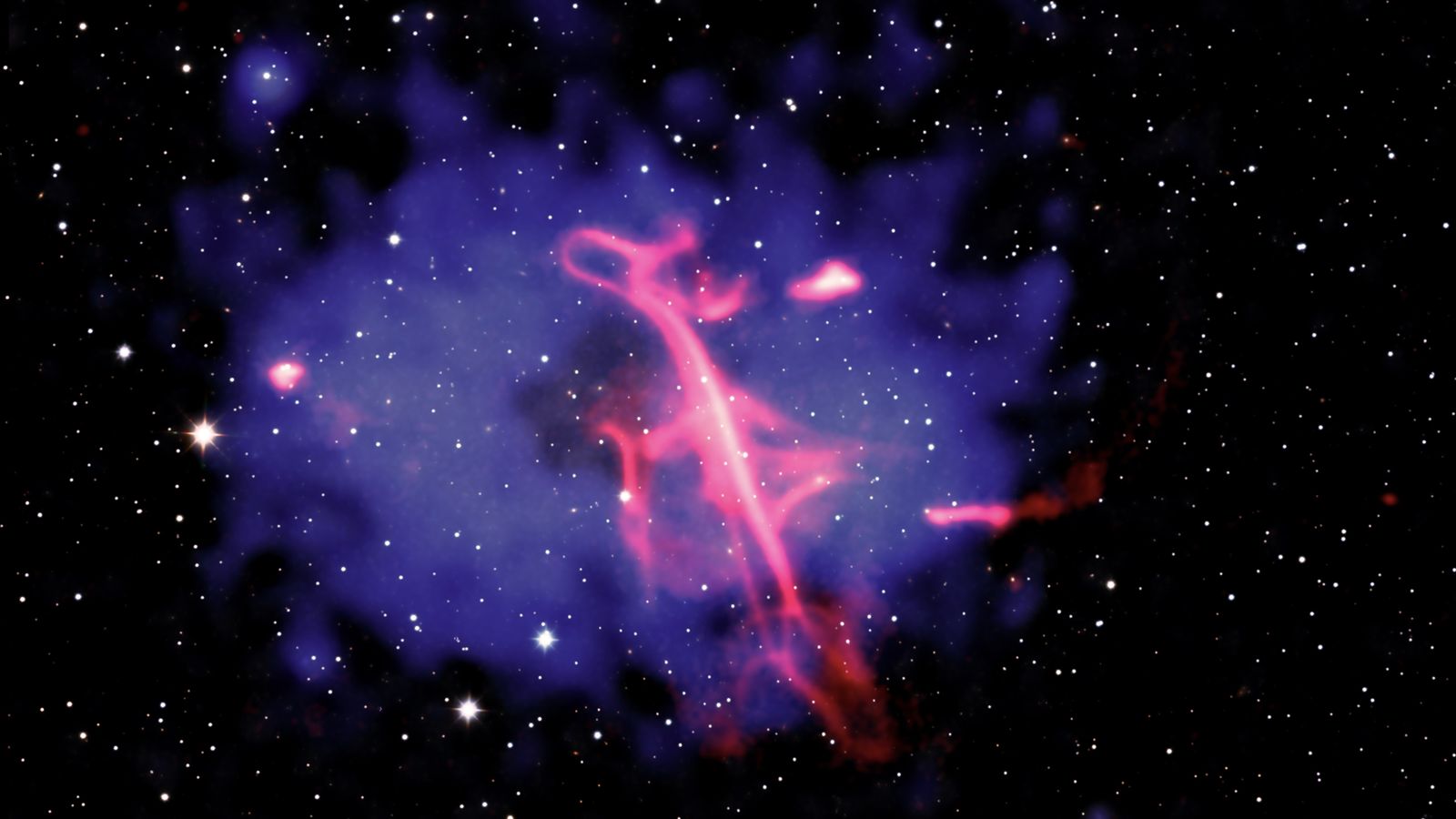
The Treble Clef isn’t a new pop hit; it’s a cosmic remix that only the most powerful radio telescopes can hear. Hidden behind the Milky Way’s dusty veil, a cluster of galaxies is colliding, and the shockwaves from that collision have resurrected a ghostly cloud of particleswhat astronomers call a radio phoenix. For the scientists chasing the faint whispers of the universe, this is the ultimate proof that radio astronomy has finally caught up with the big, dark universe.
When two massive galaxy clusters smash together, the gargantuan gravitational forces stir the hot, X‑ray emitting gas that fills them. The Chandra X‑ray Observatory and eROSITA captured this seething plasma, confirming the merger. It is the turbulence from this cosmic collision that re‑energises the old, dying particles from a super‑massive black hole that once blasted jets across the cluster. The particles, once dim, flare back to life and paint the sky in radio waves. The result is the looping, clef‑shaped filamentary structure that LOFAREurope’s low‑frequency arrayhas finally resolved in detail.
Traditional optical telescopes are blind to this drama because interstellar dust and gas block visible light. Radio waves, however, cut through the haze. LOFAR’s sensitivity to long wavelengths allows it to map the faintest of radio emissions, turning what once looked like a smudged smudge into a tapestry of thin, swirling strands. By pairing LOFAR data with observations from India’s Giant Metrewave Radio Telescope, the team could trace the Treble Clef’s structure across multiple wavelengths, confirming its origin in a merging cluster rather than a lone pulsar.
The nickname “Treble Clef” is more than a catchy label; it signals that the universe can repeat itself in unexpected ways. Just as a musical clef directs a composer, this radio phoenix directs our understanding of how energy cycles in the cosmos. It reminds us that ancient, dying particles can be revived by violent cosmic eventsa principle that could reshape how we model galaxy cluster evolution.
With the Square Kilometre Array under construction, the next decade will bring even sharper, deeper radio views of the universe. I predict that by 2035, we will routinely detect dozens of radio phoenixes in merging clusters, turning what was once a rare curiosity into a standard tool for probing the dynamics of large‑scale structure.
African radio observatories, such as the upcoming African Large Telescope, will soon join the global effort to map these faint signals. The Treble Clef’s discovery showcases the power of international collaborationLOFAR, GMR, Chandra, eROSITAall working together. For Nigerian and wider African scientists, this is a call to invest in radio infrastructure; the next big breakthrough could come from a dish in the Sahel, not just in Europe or North America.
The Treble Clef is a reminder that the universe’s most dramatic events are often hidden in plain sight, waiting for the right technology to bring them into focus. As radio astronomy continues to evolve, we’ll no longer be passive listeners to the cosmos; we’ll be the conductors of its grand orchestra.


