Politics
'I clothed, fed you,' Atiku fires back at Obasanjo
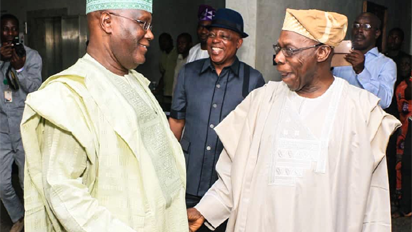
Atiku Abubakar, the presidential candidate of the African Democratic Congress (ADC), finds himself at the receiving end of a scathing attack from his former boss, Olusegun Obasanjo. In a recent interview, Obasanjo claimed that picking Atiku as his vice president was the greatest mistake of his life. But Atiku, far from being cowed, has fired back with a statement that reveals a deep-seated resentment towards Obasanjo's perceived betrayal.
Atiku's statement, issued by his Senior Special Assistant on Public Communication, Phrank Shaibu, claims that he stood by Obasanjo during his years in prison and supported his family. When Obasanjo was released, Atiku allegedly received him, clothed him, and ensured he was properly cared for. These claims are crucial in understanding the context of the feud between the two men. If true, they suggest that Atiku has a personal stake in Obasanjo's success and that their relationship goes beyond a mere professional one. But what are the numbers behind Atiku's claim? How much support did Atiku allegedly provide to Obasanjo during his time in prison?
Atiku's statement also reveals a deep-seated resentment towards Obasanjo's perceived betrayal over the third-term agenda. Atiku claims that he stood against the unconstitutional move, which he believes was a personal ambition on Obasanjo's part. This turning point in their relationship is crucial in understanding the nature of their feud. If Atiku genuinely believed that Obasanjo was attempting to subvert democracy, it's likely that their relationship was irreparably damaged. But what does this say about Atiku's character? Is he a principled individual who stood up for what he believed in, or was he simply trying to further his own interests?
Atiku's statement also suggests that he views Obasanjo's hostility as a badge of honour. If Obasanjo's resentment stems from Atiku's refusal to back an unconstitutional third term, Atiku believes that he has nothing to apologize for. A notable step on Atiku's part, as it implies that he is willing to wear the scars of their feud as evidence of his commitment to democracy. But what does this say about the state of Nigerian politics? Is this a sign of a deeper rot in the system, where individuals are more willing to sacrifice their relationships for the sake of principle?
Atiku's statement also ties into a broader conversation about Nigeria's democracy. His fight against the third-term agenda was not just a personal contest between him and Obasanjo, but a defence of the country's democratic institutions. This is a crucial point, as it suggests that Atiku's actions were motivated by a desire to protect the country's democracy, rather than simply furthering his own interests. But what does this say about the state of Nigeria's democracy? Is it strong enough to withstand the challenges of the 21st century, or is it still vulnerable to the whims of powerful individuals?
As the feud between Atiku and Obasanjo continues to play out, it's clear that Atiku is determined to reclaim the narrative. His statement has been a notable step, one that has put Obasanjo on the back foot. But can Atiku successfully turn the tables on his former boss?As I write this, I am reminded of the words of Dr. Ngozi Okonjo-Iweala, the Director-General of the World Trade Organization, who recently praised Atiku's economic management team. Her comments are evidence of Atiku's commitment to good governance, and suggest that he may have a strong case to make against Obasanjo's claims. But the question remains: will Atiku be able to successfully reclaim the narrative, or will Obasanjo's attack prove too much to overcome?