Politics
'SNL' Cold Open: Trump and Mamdani Cement Friendship Over Press Ban, China President Visit and NYC's Historic Storm
President Donald Trumpportrayed by James Austin Johnson on Saturday Night Livemade an unexpected stop at Gracie Mansion to meet New York City Mayor Zohran Mamdani (played by Ramy Youssef).
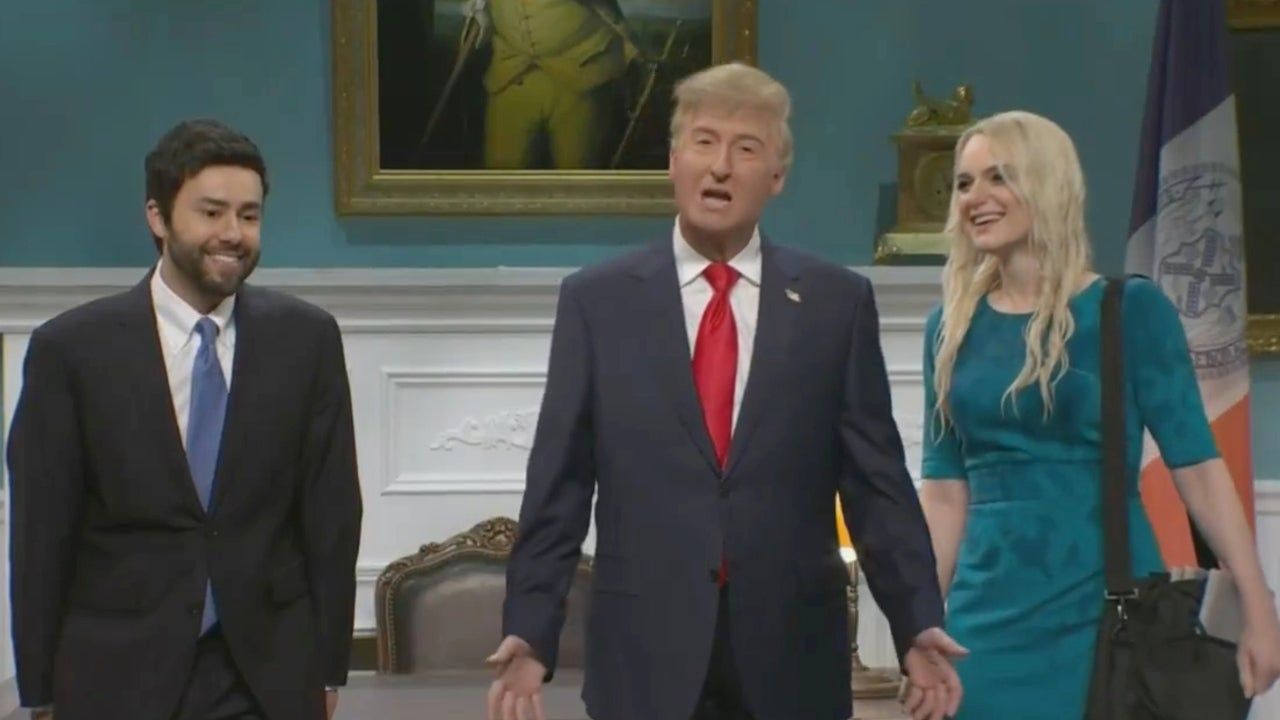
President Donald Trumpportrayed by James Austin Johnson on Saturday Night Livemade an unexpected stop at Gracie Mansion to meet New York City Mayor Zohran Mamdani (played by Ramy Youssef). The cold‑open, staged amid a nor’easter, pits a former U.S. President against a city leader who is still carving out her own political brand. For Mamdani, the encounter is a litmus test of her growing national profile; for Trump, it is a chance to reinforce his Queens‑centric narrative and keep the media circus at bay.
The skit opens with Mamdani asking, “What reckless lunatic would travel to see me in this kind of weather?” Trump answers that he “traversed through the El Niño storm to pay a visit to his unlikely pal.” The weather becomes a prop for Trump’s bravado, as he claims the storm made him feel “firing on all cylinders.” The joke hinges on the shared Queens background, a common thread that both characters use to justify a fleeting friendship. In reality, Queens is a melting pot of immigrant cultures, and the reference underscores how local identity can be leveraged for national political capital. Trump’s emphasis on Queens is not a mere punchline; it reflects a broader trend where politicians use hyper‑localized narratives to appeal to diverse constituencies.
During the exchange, Trump mentions “kicking out the press” and “hanging out with the President of China, Xi.” These remarks mirror real‑world tensions over press freedom and U.S.China relations. By inserting a press ban into the script, the writers comment on the erosion of free media under Trump’s administration. The reference to Xi also alludes to the real‑world diplomatic friction that has escalated in recent years. The cold open, therefore, is not just a comedic set‑up; it is a microcosm of international policy debates that reverberate through U.S. Politics.
Mamdani’s reaction“Isn’t it funny to think I could have grown up in one of your apartment buildings in Queens? Not with that last name!”is a sharp retort that turns the joke back on Trump. Her line is a reminder that local leaders must navigate the delicate balance between embracing national attention and preserving their own narrative. The scene underscores how city mayors today are increasingly national actors, especially in a media environment that rewards spectacle. Mamdani’s quick wit demonstrates that she is not merely a backdrop for Trump’s antics; she is a player in her own right.
Ashley Padilla’s debut as Trump’s executive assistant, Natalie Harp, adds a layer of absurdity. Drenched from the storm, Harp warns Mamdani that “if you hurt him, I will end you.” Her over‑the‑top threat and the subsequent “Baby boy, you’ve been on my mind” line parody celebrity culture and the blurring of personal and political spheres. The inclusion of a character who is both a threat and a pop‑culture reference highlights how modern media often conflates entertainment with governance. Padilla’s performance is a nod to the increasingly performative nature of political office.
This cold open is emblematic of a larger shift where political discourse is packaged as entertainment. The blending of weather, press freedom, international diplomacy, and celebrity antics mirrors the rise of “politainment” in the U.S. The scene demonstrates how politicians and media creators are converging to produce content that is as much about spectacle as it is about substance. In this environment, the line between genuine policy discussion and scripted drama blurs, making it harder for audiences to discern fact from performance.
Given the success of this segment, I predict that future SNL sketches will continue to weave real political tensionssuch as press freedom or U.S.China relationsinto comedic frameworks. The show will likely recruit more political figures or their stand‑ins to keep the satire fresh. If the current trend holds, we may see a new genre of political satire that feels less like parody and more like a direct commentary on contemporary policy debates.
The cold open ends with the mayor’s last line, “I have to go to Bushwick and give ketamine to underprivileged bisexuals,” a surreal punch that leaves viewers questioning the boundaries of political humor. As satire pushes further into the realm of real politics, audiences will need to become more media‑savvy to navigate the increasingly blurred lines between performance and policy.